 Sunny Days
Decorative Finishes
The part that decides whether it looks poured or designed.
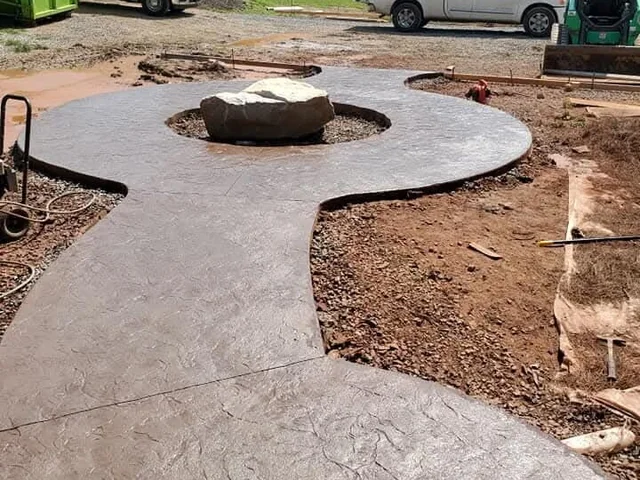
Stamped Concrete
Stone, brick or plank, in one continuous pour.
Their own words: patterns and colors that mimic natural stone, brick or wood.
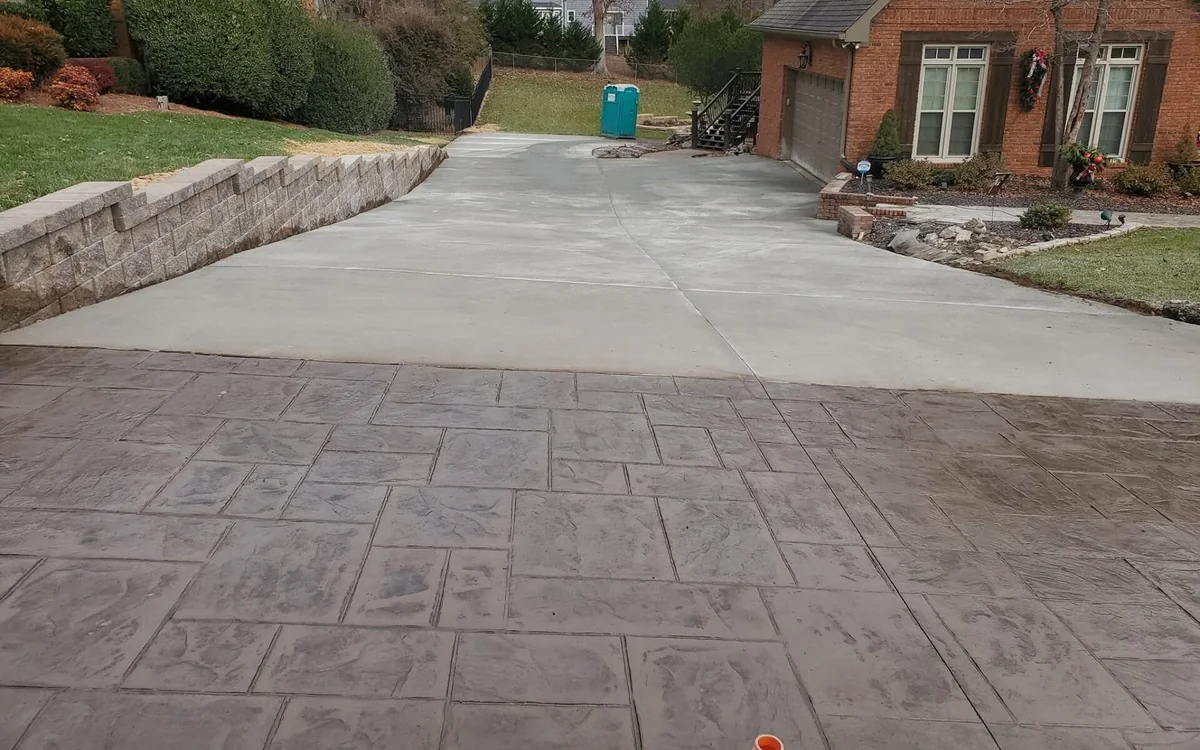
One pour, one surface, and no joints for weeds to find.
Stamped concrete is pressed with a pattern while it is still plastic, so a slab that reads as stone or brick is in fact a single continuous pour. Nothing settles independently, nothing shifts out of line, and there are no sand joints to weed or re-sand.
Their own services page calls this out by name: patterns and colors that mimic natural stone, brick or wood, for patios, walkways and pool decks. It is the work their best photographs show.
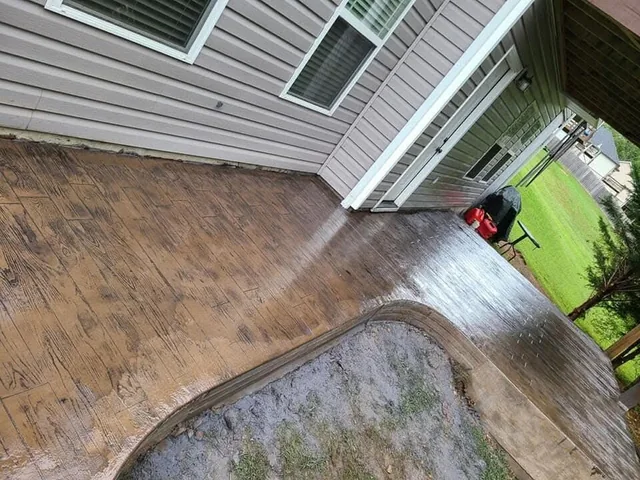
How a stamp goes down
- Color in the mix, or a color hardener broadcast and floated in
- Release agent over the surface so the mats lift cleanly
- Mats pressed in sequence while the slab is still open
- Joints cut through the pattern, placed where they read as part of it
- Washed off, then sealed, which is what brings the color up
Stamp patterns
Four of the common families. The pattern decides the scale of the surface more than the color does: a big ashlar makes an area read larger, a brick stamp makes it read busier.
Rectangles of several sizes, laid in a repeating block. The most common stamp on a driveway or a large patio, because the varied sizes stop the repeat being obvious and the scale suits a big area. Their stamped driveway is this family.
Color & Stain
The orange you see on day one is not the color.
Integral color, color hardener, release and stain, then sealer.
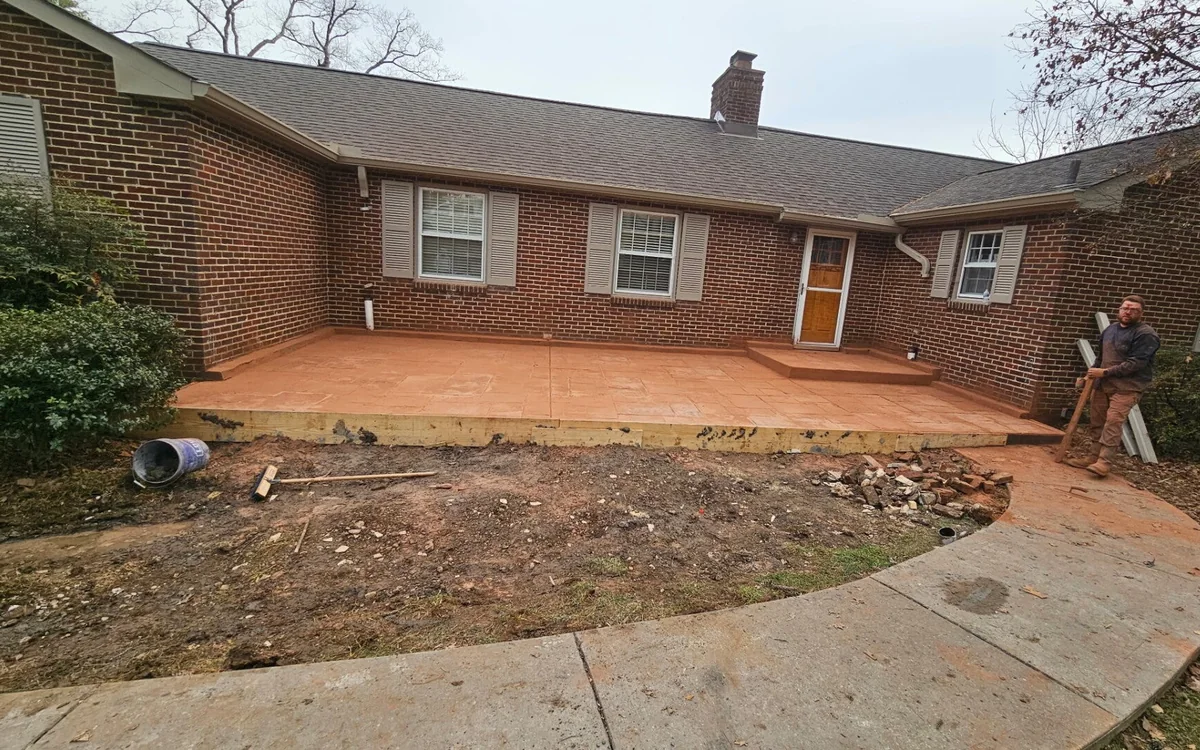
The orange you see on day one is not the color.
Stamped work usually gets an antique release powder, which is what stops the mats sticking. It is strongly colored, and for a day or two the patio looks like terracotta. It washes off, and what is underneath is the actual color: quieter, more varied, and with the release left only in the low points of the texture, which is what gives the surface its depth.
It is worth knowing before the crew leaves, because a homeowner looking at the release coat and expecting the finished color is looking at the wrong thing. There are two photographs of the same patio on this site, one with the release on and one after the sealer, and they are the same slab.
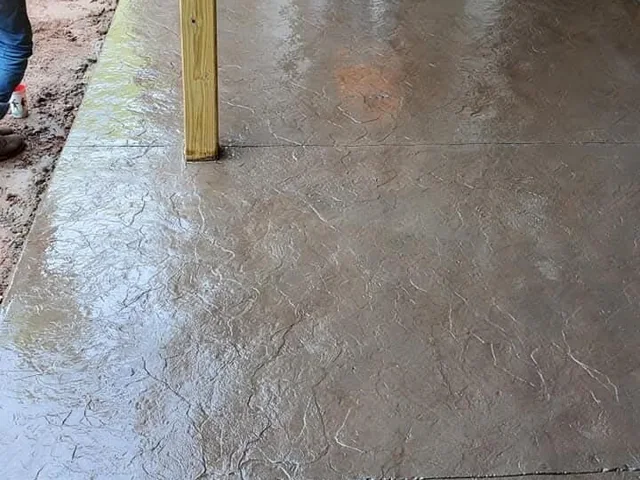
Four ways color gets into concrete
- Integral color, mixed at the plant, so the color goes all the way through
- Color hardener, broadcast on the surface and floated in, which is stronger and brighter at the top
- Antique release, which colors the low points of a stamp and washes off the high ones
- Acid or water-based stain, applied to a slab that has already cured
- Sealer last, which is what makes any of it look wet and rich rather than chalky
Where the color comes from
These are methods rather than a product range: the swatches show the kind of result each one gives, not a color chart to order from.
Pigment in the truck, so the color runs through the whole slab. The most even result and the one that survives a chip or a saw cut, because what is underneath is the same color. Softer and more muted than a hardener, and the most expensive way to color a large pour.
Brick Borders
A brick edge turns a slab into a shape.
A laid brick band around a poured field, which is a masonry job and a concrete job at once.
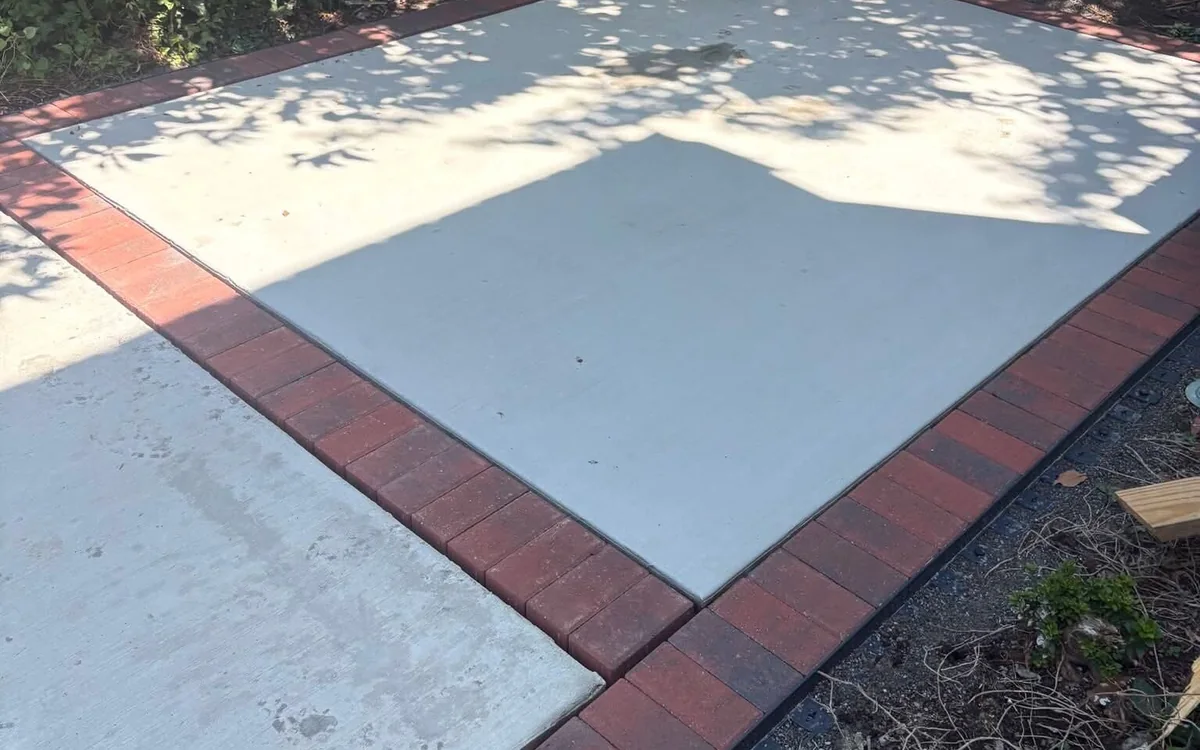
A brick edge turns a slab into a shape.
A poured field with a laid brick band around it is two trades meeting in one job, which is the thing this company is actually set up to do. The concrete gives you a continuous surface with no joints to weed; the brick gives you an edge with a line, a color and a scale that a saw cut cannot produce.
It also solves a real problem. A curve in plain concrete is just concrete that bends. A curve with a brick band running around it reads as a decision, and the band hides the edge where the form was.
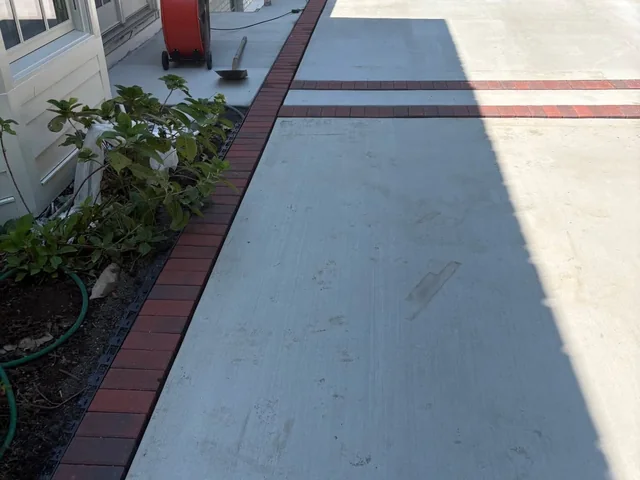
Where the band goes
- Around the whole perimeter, which is what defines the shape
- Across the field as a cross band, to break up a long run
- Following a curve, cut tight so the joints stay even
- Between a new pour and an existing surface, to hide the junction
- Laid on a bed rather than butted to the slab, so it holds its line
How the band is laid
The same brick looks like a different job depending on which way it is turned and how many courses run. All four of these are in their photographs.
Brick laid flat, face up, running around the edge. The widest band for the fewest bricks, and the one in most of their photographs. Reads calm, and gives a generous border without taking a lot out of the field.
Repair & Resurfacing
Not every bad slab needs replacing. Some of them do.
Their own words: from cracks to crumbling surfaces, restoring safety and appearance.
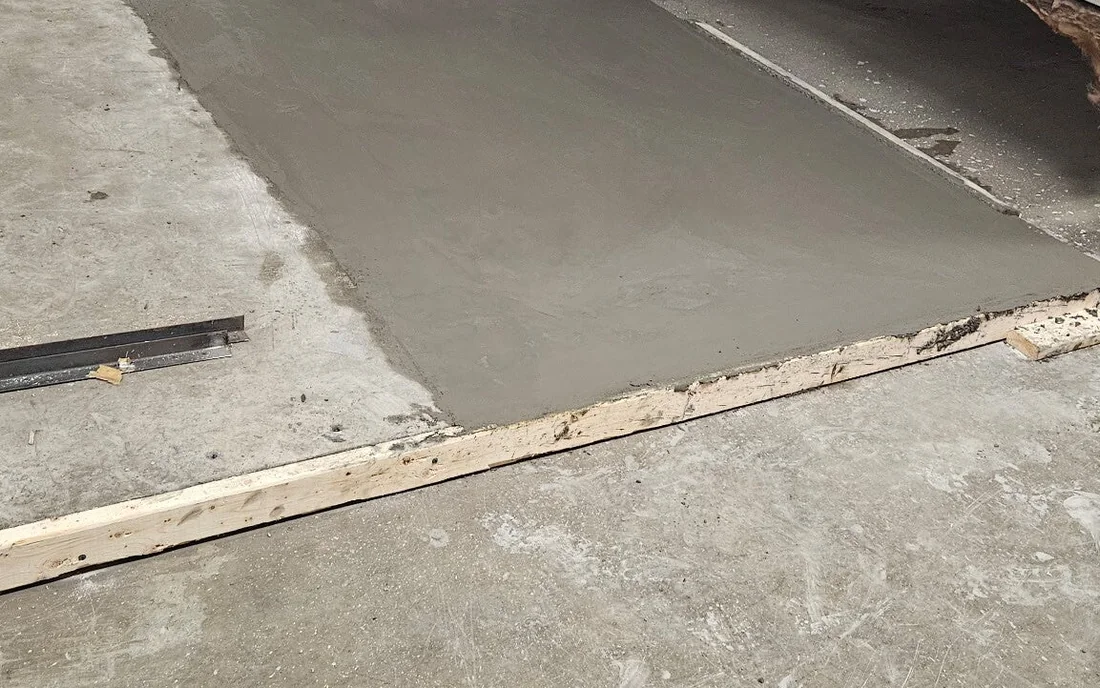
The honest answer is sometimes replace it.
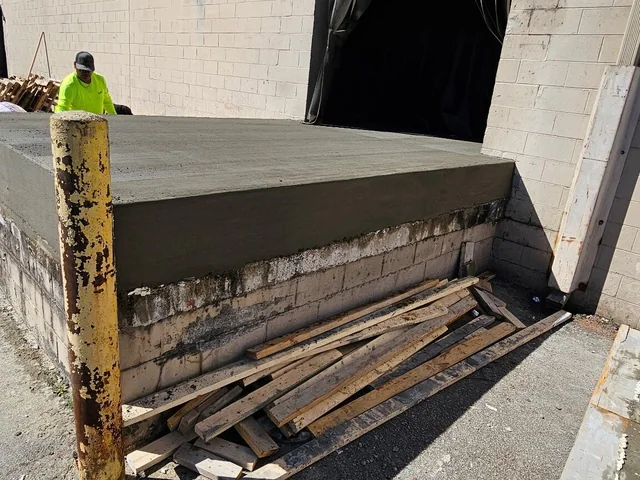
Their own services page puts it plainly: from cracks to crumbling surfaces, restoring the safety and appearance of concrete and masonry. The useful distinction is between a slab that has a problem and a slab that is a problem. A hairline crack in a sound slab is cosmetic. A slab in three pieces that rock when you stand on them is telling you the ground under it moved, and resurfacing it just puts a new face on the same movement.
So the first question on a repair is not what it costs. It is what caused it, because that decides whether anything put on top will last.
What usually gets found
- Settlement, where washed-out or uncompacted ground let one part drop
- Edge and corner breakup, usually from water getting under the slab
- Lipped joints at a walk, which is a trip hazard before it is a looks problem
- Scaling and spalling, where the surface is coming off in flakes
- Cracks that follow no joint, which is the slab telling you where it wants one
What is actually wrong with it
Tick what applies. This counts what you picked and says what it means for the visit. It does not diagnose your slab and it does not quote.
Questions
Questions people actually ask.
Stamped Concrete
Is stamped concrete slippery?
Sealed and wet, it can be. A grit additive in the sealer takes most of that away, and it is worth asking for anywhere that gets rained on and walked on, which in Chattanooga is everywhere.
Does it need resealing?
Yes. The sealer is what holds the color and the sheen, and it wears. How often depends on sun, traffic and the product, which makes it a question for the crew that sealed it.
Will the pattern repeat visibly?
A mat set repeats, so set-out matters. Ashlar and seamless hide it best. A plank or brick stamp run across a big open area is where a repeat becomes obvious.
Can an existing slab be stamped?
Not stamped, no: stamping happens in wet concrete. An existing slab can sometimes take a stamped overlay instead, which is a different product with a different lifespan.
Color & Stain
Why does my new patio look orange?
That is almost certainly antique release still on the surface. It washes off, and the color underneath is the one that was chosen. Ask when the wash and seal is happening rather than assuming the color is wrong.
Will two pours match?
Not exactly. Concrete color varies with the batch, the weather and how it was finished, and it keeps changing for weeks as it cures. Plan a deliberate break between old and new rather than hoping for a match.
Can color be added to a slab I already have?
Acid or water-based stain, yes. Integral color and hardener both have to happen at the pour, because both are in or on the concrete while it is still wet.
Does color fade?
Pigment itself is stable. What changes is the sealer and the surface: traffic and sun dull the finish, and the color looks faded because the sheen went. Resealing usually brings it back.
Brick Borders
Does the brick move separately from the slab?
It can, which is why it is bedded rather than just set against the concrete. A band laid loose against a slab is the part that lifts first.
Can the border be stamped instead of laid?
Yes, a brick-pattern stamp gives you a border in the same pour. It costs less and it never moves; it also never has the color depth of real fired brick, which is the whole reason people want the band.
Can you match the brick on my house?
Sometimes. Brick runs in batches and older brick has weathered, so an exact match is rare. A deliberate contrast usually reads better than a near miss.
Is it only for patios?
No. Their photographs show it around parking pads, down the edges of walks and as a cross band across a long run.
Repair & Resurfacing
Can a crack be filled?
A crack in a slab that is not moving can be routed and filled, and it will stay filled. A crack in a slab that is still moving will reopen, usually within a season, so the filling is only worth doing once the movement has been dealt with.
What is resurfacing?
A thin cementitious overlay bonded to the old slab, which can be plain, colored or stamped. It is a real option on a sound slab with a bad surface, and a waste of money on one that is moving.
Can you lift a settled slab instead of replacing it?
Slab lifting is a specialist process using injected foam or grout. Whether it is the right call depends on why the ground went, which is a site visit question rather than a web page question.
What should I send you?
Photographs, and one of them taken low along the surface rather than from standing height. A lip or a rock is almost invisible in a photograph shot from above and obvious in one shot along the slab.
Decorative Finishes
The part that decides whether it looks poured or designed. Send photos of the space and someone will come and look at it.